Piling Design, Testing & Certification
|
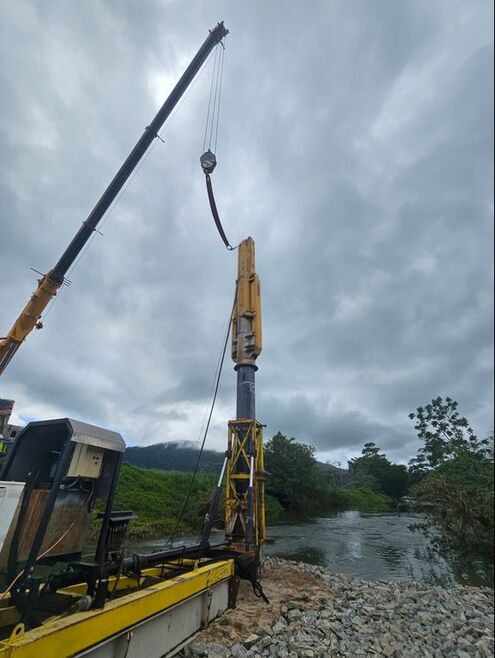
We provide design and consultation services for various steel and concrete driven pile configurations. We utilise advanced modelling software alongside site instrumentation to support our designs.
Our core services include:
|
Bored Piers, Driven Piles, Concrete Piers & Screw Pile Foundations
We design and certify bored piers, driven steel piles, concrete piers and screw pile foundations in accordance with AS 2159 (Piling — Design and Installation), AS 3600 (Concrete Structures) and AS 5100 (Bridge Design). Each pile configuration is selected based on soil conditions, load requirements and site conditions.
Pile Integrity Testing
Low-strain Pile Integrity Testing (PIT) is a non-destructive method used to assess the length and structural condition of bored piers, driven piles and existing foundations. We use the Pile Integrity Tester (PIT) by Pile Dynamics Inc., the industry standard instrument for low-strain testing.
The test works by coupling a high-sensitivity accelerometer to the pile head and striking the pile with a calibrated handheld hammer. The impact generates a compressive stress wave that travels down the pile at a speed determined by the concrete wave speed. When the wave encounters a change in cross-sectional area, a crack, a void, or the pile toe, part of the wave is reflected back to the surface and recorded by the accelerometer.
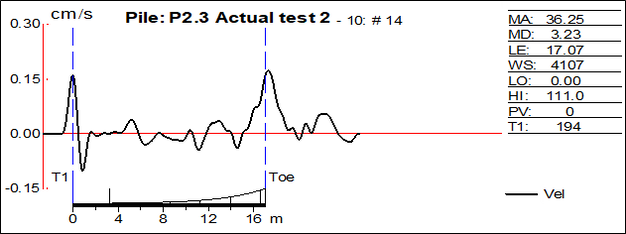
The resulting picture known as a reflectogram is analysed to determine pile length, identify defects and assess overall structural integrity. A clean pile produces a single clear reflection from the toe. Anomalies such as necking, cracking or areas of reduced concrete quality produce additional reflections at intermediate depths, allowing us to locate and characterise the defect.
A critical but often overlooked step is calibrating the wave speed input used by the PIT software. The wave speed of concrete varies depending on compressive strength, mix design and age. We use Ultrasonic Pulse Velocity (UPV) testing to measure the actual wave speed of the pile concrete before analysis. This ensures depth calculations in the reflectogram are accurate rather than based on assumed values, significantly improving the reliability of the result.
We use multiple sensors where required to improve accuracy on complex piling arrangements
The test works by coupling a high-sensitivity accelerometer to the pile head and striking the pile with a calibrated handheld hammer. The impact generates a compressive stress wave that travels down the pile at a speed determined by the concrete wave speed. When the wave encounters a change in cross-sectional area, a crack, a void, or the pile toe, part of the wave is reflected back to the surface and recorded by the accelerometer.
The resulting picture known as a reflectogram is analysed to determine pile length, identify defects and assess overall structural integrity. A clean pile produces a single clear reflection from the toe. Anomalies such as necking, cracking or areas of reduced concrete quality produce additional reflections at intermediate depths, allowing us to locate and characterise the defect.
A critical but often overlooked step is calibrating the wave speed input used by the PIT software. The wave speed of concrete varies depending on compressive strength, mix design and age. We use Ultrasonic Pulse Velocity (UPV) testing to measure the actual wave speed of the pile concrete before analysis. This ensures depth calculations in the reflectogram are accurate rather than based on assumed values, significantly improving the reliability of the result.
We use multiple sensors where required to improve accuracy on complex piling arrangements


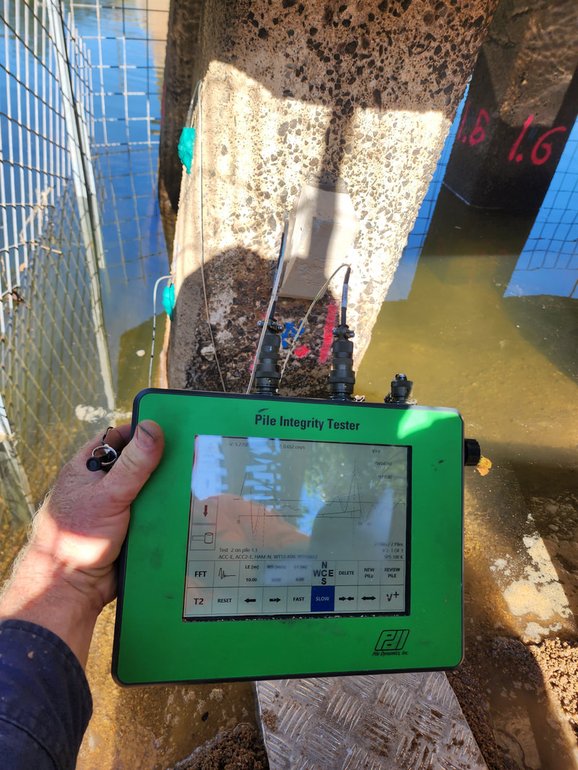
Dual Accelerometer measurement for more complicated piling arrangements
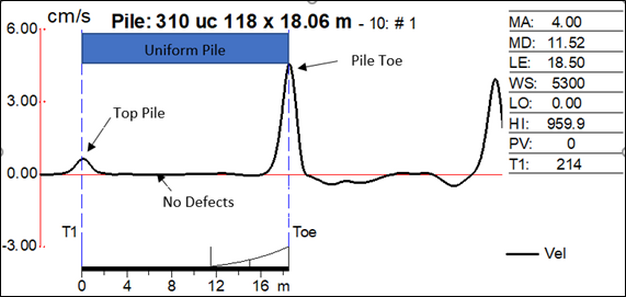
A pile with issues produces reflections at multiple points.
Temporary Compression in Piles
During driving, a pile behaves like a high-tension spring. As the hammer strikes, an energy wave travels to the toe to overcome friction and advance the pile. A portion of this wave reflects back to the surface; it is this precise principle of wave reflection that allows us to perform low-strain pile integrity testing as per below to verify structural health.
Foundation Repair & Temporary Works
We also provide temporary works design and certification for piling operations requiring shoring, propping or load redistribution during construction.