
Concrete Inspection, Testing & Integrity Analysis Qld
We provide comprehensive concrete inspection and testing services for concrete using non-destructive testing (NDT), chemical analysis, and detailed investigation. We specialise in identifying critical issues such as reinforcement corrosion, carbonation, and physical degradation from alkali-silica reaction (ASR) or alkali-aggregate reaction (AAR).
Our data-driven approach helps us provide asset owners the current condition and remaining service life of their structures.
Our data-driven approach helps us provide asset owners the current condition and remaining service life of their structures.
Concrete Strain Measurement & Structural Health Monitoring
Strain gauges can be installed on concrete structures just like steel and timber. These gauges are generally much longer (60mm+) than those used for steel to account for the variable modulus of concrete. This increased length ensures that the measurement averages the different compression rates of large aggregate, sand, and cement.
For more information, see our Strain Measurement page.
For more information, see our Strain Measurement page.
Concrete Carbonation Testing
Carbonation testing is a common method used to measure the remaining protective properties of concrete. As concrete ages, its alkalinity reduces from the surface inwards, eventually leading to reinforcement corrosion. To identify this on-site, we use a phenolphthalein indicator solution on freshly exposed concrete.
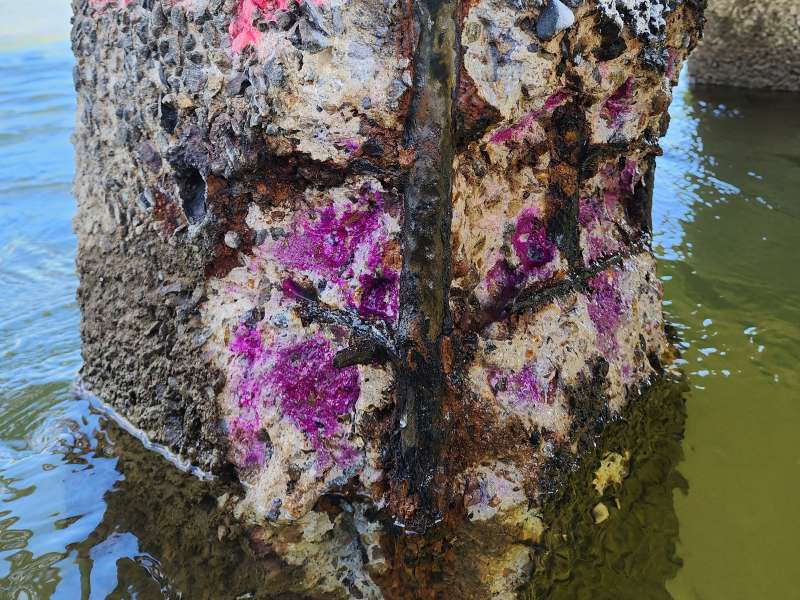
As seen in the photos, where the solution turns a vibrant purple, the alkalinity of the concrete is still providing protection to the reinforcement.
Because carbonation levels are often non-uniform across a structure, some areas will suffer from spalling much earlier than others. To move beyond surface observations or mass core sampling, the use of NDT methods such as Half-Cell Testing and Ultrasonic Pulse Velocity (UPV) is critical. These methods allow us to map active corrosion and internal voids that are not yet visible, providing a complete structural health assessment and ensuring repair scopes are accurate and targeted.
As seen in the photos, where the solution turns a vibrant purple, the alkalinity of the concrete is still providing protection to the reinforcement.
Because carbonation levels are often non-uniform across a structure, some areas will suffer from spalling much earlier than others. To move beyond surface observations or mass core sampling, the use of NDT methods such as Half-Cell Testing and Ultrasonic Pulse Velocity (UPV) is critical. These methods allow us to map active corrosion and internal voids that are not yet visible, providing a complete structural health assessment and ensuring repair scopes are accurate and targeted.


Concrete Reinforcement Cover
While reinforcement cover measurement is used to determine the depth of concrete over reinforcing steel, our advanced concrete scanning equipment typically displays this data on-screen, often negating the need for a separate cover meter.

Cover meter used for deep reinforcement location
Reinforcement Corrosion - Half Cell Testing
Half Cell testing refers to a method of corrosion mapping.
The instrument uses a clamp and probe to create a low voltage electrical circuit from the reinforcement, through the concrete. Changes in corrosion levels affect the flow of electricity through the concrete and back to the probe.
Typically, we combine this method with concrete scanning and carbonation testing to locate, and core adjacent to reinforcement to allow bonding of the half-cell instrument earth and attain a sample for carbonation testing.
It has proven very effective at mapping internal corrosion in areas where there is no apparent degradation. It is also a very useful test for mapping the limits of a corroded area to allow for more controlled project planning and expenditure
The instrument uses a clamp and probe to create a low voltage electrical circuit from the reinforcement, through the concrete. Changes in corrosion levels affect the flow of electricity through the concrete and back to the probe.
Typically, we combine this method with concrete scanning and carbonation testing to locate, and core adjacent to reinforcement to allow bonding of the half-cell instrument earth and attain a sample for carbonation testing.
It has proven very effective at mapping internal corrosion in areas where there is no apparent degradation. It is also a very useful test for mapping the limits of a corroded area to allow for more controlled project planning and expenditure


Concrete Compressive Strength Testing
Compression testing of concrete typically falls into two categories - Destructive via core sampling, or Non-destructive via Schmidt Hammer. Both have their respective places in engineering inspection & assessment.
Compressive Strength Testing using Schmidt Hammer
Schmidt hammers are mechanically actuated instruments that measure how much energy concrete reflects when struck.
They offer an inexpensive and non-intrusive approach to testing of the compressive strength of concrete and are a commonly used method for existing structures.
Through years of research, common rebound curves have been developed for general assessment of compressive strength.
We carry both mechanical Schmidt Hammers for general site work and modern day programmable Schmidt Hammers.
On new projects, programmable Schmidt Hammers act as a method of quality control for checking concrete curing rates, and provide a method of measurement and sign off for early formwork stripping.
This significantly cuts down on the amount of concrete test cylinders required for projects requiring constant movement of formwork.
In their deprogrammed or raw mechanical state however, Schmidt hammers are considered a blunt instrument.
Do not let an engineering consultancy or contractor sell you information based on uncorrected Mechanical Schmidt hammer results alone without having the test data to back it up.
They offer an inexpensive and non-intrusive approach to testing of the compressive strength of concrete and are a commonly used method for existing structures.
Through years of research, common rebound curves have been developed for general assessment of compressive strength.
We carry both mechanical Schmidt Hammers for general site work and modern day programmable Schmidt Hammers.
On new projects, programmable Schmidt Hammers act as a method of quality control for checking concrete curing rates, and provide a method of measurement and sign off for early formwork stripping.
This significantly cuts down on the amount of concrete test cylinders required for projects requiring constant movement of formwork.
In their deprogrammed or raw mechanical state however, Schmidt hammers are considered a blunt instrument.
Do not let an engineering consultancy or contractor sell you information based on uncorrected Mechanical Schmidt hammer results alone without having the test data to back it up.


Concrete Compressive Strength Testing using Core Samples
Taking core samples is a great way to better understand concrete strength.
A suitable area for coring is first determined based on the geometry of the structure. Careful consideration to structural integrity is considered before all coring activities. Concrete scanning is then employed in order to ensure no reinforcement or electrical sources are present. Once the core is removed, the hole is thoroughly cleaned backfilled with a high grade epoxy.
The core sample is immediately placed in water, transported to base and processed into set sample lengths. An accredited laboratory is then engaged to perform compressive strength testing of the samples and provide a compressive strength report.
A suitable area for coring is first determined based on the geometry of the structure. Careful consideration to structural integrity is considered before all coring activities. Concrete scanning is then employed in order to ensure no reinforcement or electrical sources are present. Once the core is removed, the hole is thoroughly cleaned backfilled with a high grade epoxy.
The core sample is immediately placed in water, transported to base and processed into set sample lengths. An accredited laboratory is then engaged to perform compressive strength testing of the samples and provide a compressive strength report.
Case Study- Comparison between concrete coring & Schmidt hammer methods to attain compressive strength
The below is a very good example on why coring is the preferred method of compressive strength testing when possible for setting the baseline. A few years ago, mechanical Schmidt hammer testing was performed on an area of concrete adjacent to a core sample.
As shown, site testing achieved a result of 50-60 MPA using a Mechanical Schmidt Hammer.
Under laboratory compressive testing however, the compressive strength of the core sample was below 20 MPA.
Such a large deviation in measurement can prove dangerous for those only using a Schmidt Hammer to form their assessment.
Having not just part of, but all the tooling (Concrete scanners, core drills, site power and water, hand tools, Class H dust extraction) is required to perform a professional operation.
As shown, site testing achieved a result of 50-60 MPA using a Mechanical Schmidt Hammer.
Under laboratory compressive testing however, the compressive strength of the core sample was below 20 MPA.
Such a large deviation in measurement can prove dangerous for those only using a Schmidt Hammer to form their assessment.
Having not just part of, but all the tooling (Concrete scanners, core drills, site power and water, hand tools, Class H dust extraction) is required to perform a professional operation.


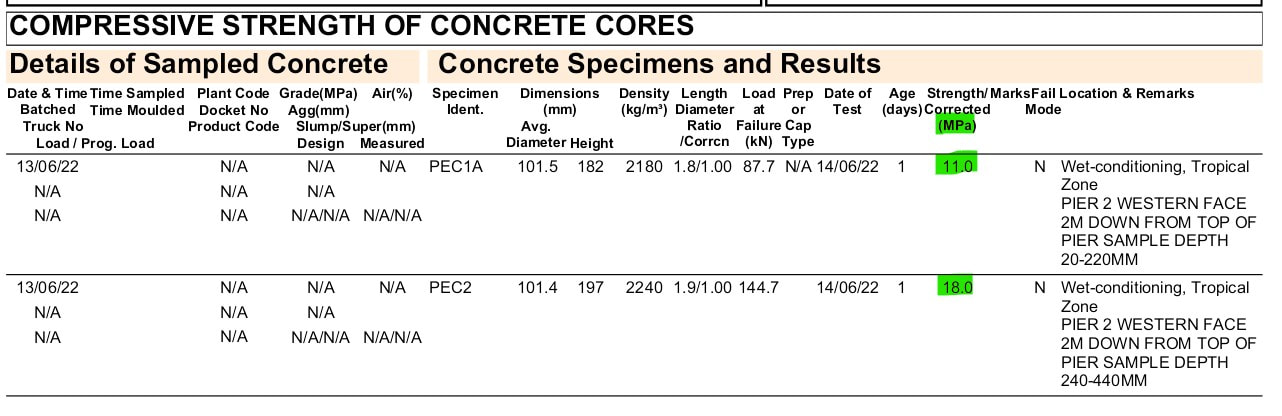
Compressive strength testing results of sample removed from site
Combined Method - What we do
In order to make full use of our programmable Schmidt Hammer, we first take core samples and test the sample both in its pre crush state as a prepared cylinder, as well as prior to the core being removed. Once laboratory compressive testing has concluded, the results are then fed back into the programmable Schmidt hammer software to create a correction curve. This means that the hammer will now give much more accurate results when testing the remaining areas of a structure, substantially cutting down on concrete coring and providing a more realistic site result.
Concrete Testing - Ultrasonic Pulse Velocity
Ultrasonic Pulse Velocity (UPV) is a method to understand the internal characteristics of concrete, in particular, the speed that energy travels through concrete. It is useful for checking homogeneity of concrete (walls, slender piles and piers in particular) as well as depth of cracks in concrete.
UPV also compliments other test methods such as Pile Integrity Testing in which the wave speed measurement of the concrete can be entered into the software of the Piling Instrument, improving on data.
UPV also compliments other test methods such as Pile Integrity Testing in which the wave speed measurement of the concrete can be entered into the software of the Piling Instrument, improving on data.
Concrete Scanning (Also Known as Concrete X-Ray and GPR)
We employ the latest in technology Ground Penetrating Radar (GPR) to allow for the detection, depth and location of steel reinforcing, electrical conduits and post tensioning cables. Other than for rebar location, this is used in a variety of manners from ensuring that the area is free of hidden objects before core drilling in supermarkets and buildings, to estimation of slab thickness and detection of piles.
A recent example of other benefits of GPR is on a bridge where a timber pile rotted away, producing a large void detected by the scanner during reinforcement location. Subsequent exposure of the pile revealed the full extent of the damage as shown below:
A recent example of other benefits of GPR is on a bridge where a timber pile rotted away, producing a large void detected by the scanner during reinforcement location. Subsequent exposure of the pile revealed the full extent of the damage as shown below:


