
Strain Measurement & Structural Load Monitoring
Strain Measurement using Mechanical Strain Gauges

|
Mechanical Strain Gauges
Mechanical strain gauges are used both for initial structural inspections and ongoing condition monitoring. They provide valuable insight into structural movements that cannot be readily detected by the human eye or measured using the basic hand tools typically used by most engineering consultancies. Application Pyramid Engineering carries a variety of mechanical strain gauges in different lengths. Small pins or aluminium blocks are epoxy-glued to structural components in bulk. An anvil, matched to the length of the gauge, is then used to create two small indents in the aluminium to establish precise measurement points. As there are no limits on the angle or configuration of these points, it is common to perform an array of measurements using a single common reference point. General applications include:
Performing repeatable mechanical strain measurements requires significant technical skill and experience. While the accuracy is high, mechanical strain is generally applied during the initial stages of a project to help locate areas of interest and reduce the total number of bondable strain gauges required. Safety The operator must be physically present during the measurement period, which typically involves standing close to a structure during normal operation. Depending on the industry or specific structural concerns, this is not always possible. In such cases, we utilise the alternative measurement methods shown below. Limitations Physical access to a specific measurement point is the primary constraint. Mechanical strain measurements are typically taken from the waterline to the top of a structure, provided appropriate access is available. |
Mechanical Strain Measurement in practice
Strain Measurement using Adhesive Strain Gauges

Waterproof 3 Axis Rosette Strain Gauge

Waterproof 2 Axis Rosette Strain Gauge

Typical electrical cubicle including Data logger, power source and signal conditioning circuits.

Single Axis Gauges in Full Bridge Configuration
|
Adhesive strain gauges are small, single-use sensors designed to measure strain across various materials without needing a technician physically present at the measurement point.
We can monitor up to eight points simultaneously at high speeds (up to 100Hz), providing a detailed view of structural behaviour. Applications While we select specific gauges to suit each project's unique requirements, we maintain a large stock of standard sizes for general applications and emergency projects. Typical applications include:
Quality & Preparation We exclusively use high-quality sensors from TML Japan to ensure excellent accuracy and repeatability. To install them, we grind and polish a small area of the structure and attach the gauge using specialised adhesives. Waterproof versions are also available for exterior or exposed environments. How Strain Gauges work Strain gauges use a fine strand of foil and a very low DC voltage. As the structure moves, the electrical resistance in the foil changes. Our equipment converts these signals into a digital data stream that can be viewed on-site or recorded by a data logger. We then export this data into Excel to convert strain measurements into stress values. Measurement Periods:
Safety Because these sensors record data remotely, there is no need for personnel to be near the structure during testing. This allows normal operations to continue without interruptions, making it an ideal solution for 24-hour facilities or critical infrastructure like road and rail bridges. 
Multichannel array in weatherproof enclosure for long term measurement
|
|
|
Case Study: Rail Bridge Assessment
During dynamic strain measurement of a rail bridge, we compare the tensile and compressive loads in the girder flanges against numerical modelling. This creates a vital cross-check to ensure theoretical calculations align with real-world structural behaviour. Key Benefits Strain measurement is invaluable because measured results are often lower than theoretical predictions. This provides a quantifiable way to safely refine models, ensuring engineering advice is both practical and backed by field data. |
Strain Gauges - Managing Data Integrity
Data integrity is paramount.
We use a regimented process to inspect and test equipment before deployment, verify live data streams during measurement,
and perform post-project verification at our facilities.
This methodical process safeguards individual measurements against the impact of configuration changes throughout data capture.
An example of how "Good Data" looks is below:
We use a regimented process to inspect and test equipment before deployment, verify live data streams during measurement,
and perform post-project verification at our facilities.
This methodical process safeguards individual measurements against the impact of configuration changes throughout data capture.
An example of how "Good Data" looks is below:

Ensuring good data integrity is essential when performing strain measurement.
Bolt on Strain Gauges

Bolt on strain gauge installed onto 250UC column. Area milled flat prior to installation using our portable milling machine.
|
Bolt-on strain gauges are specifically designed for long-term monitoring and performance in harsh mechanical environments. Unlike one-time sensors, these are durable units ideal for continuous data collection.
Applications These gauges are commonly used on silos, tanks, and hoppers. They also play a vital role in the logic control of industrial equipment, providing real-time monitoring through standard 4-20mA signal outputs to track specific load requirements. Quality & Preparation For these sensors to be effective, they must be installed on a perfectly flat surface to avoid false readings from torsional load. At Pyramid Engineering, we use portable milling equipment to machine a smooth, precise surface for every installation—a critical step that is often overlooked. Calibration Bolt-on sensors do not come pre-calibrated with a set gauge factor. To ensure accuracy, we apply a known test load to the area after installation to sync the gauge and confirm repeatable results. Limitations The primary requirement is enough space for our milling equipment to create a flat mounting surface. Generally, steel columns or sections with a web width of 200mm or greater are suitable for these installations. |
Calibration of Strain Gauges

Validation of strain loading through use of loading assembly
designed specifically for project requirements.
|
During strain measurement, we often perform a test load or setup validation to ensure the data is accurate. For bridges, this typically involves moving a locomotive or a weighted truck over the specific area of interest. This real-world loading is essential for calibrating and refining computer models.
Custom Loading Solutions In cases where loads are unknown, or a standard test load cannot be applied, we design and fabricate custom loading assemblies. This allows us to provide a controlled dataset with known values, ensuring the integrity of the measurement even in complex environments. Precision for Bolt-on Sensors Test loading is particularly critical for bolt-on strain sensors. Simply filling a silo or hopper is often an unreliable calibration method, as material distributes unevenly across different columns. This can lead to sensors being calibrated to different strain levels, resulting in poor accuracy when the hopper is only partially full. By applying a specific, controlled load, we ensure each sensor provides consistent and reliable data across all operating conditions. |
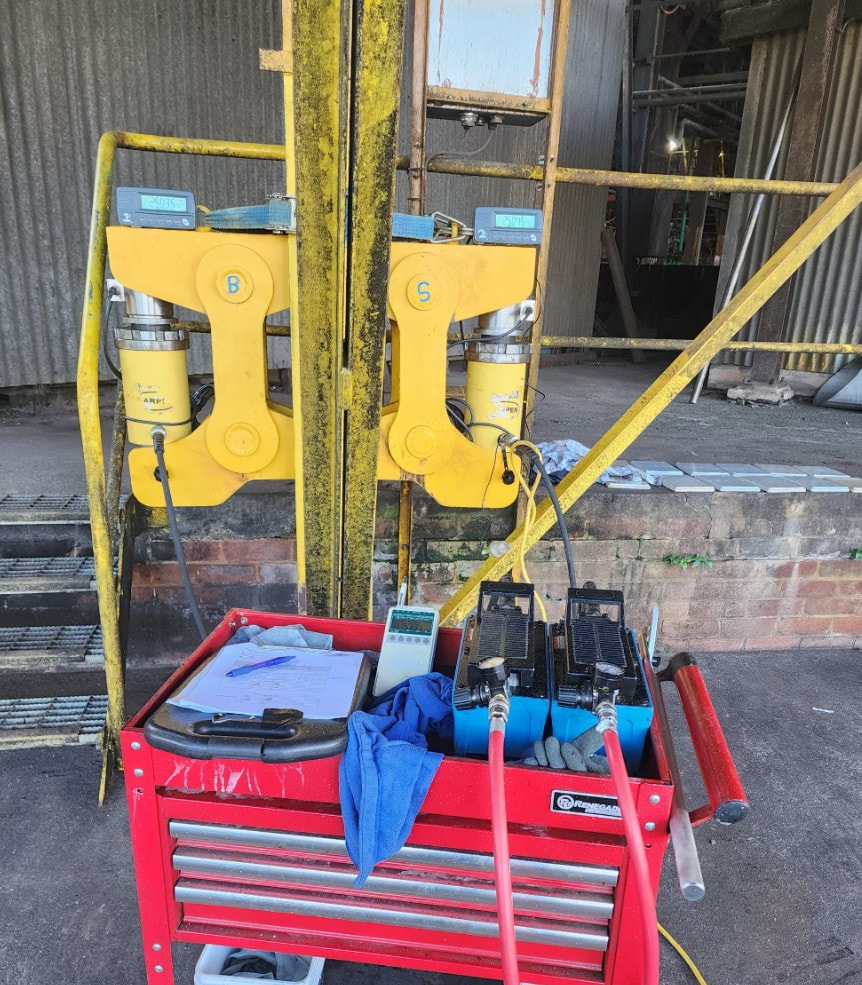
Dual 80 Tonne Calibration Assemblies
|

Pre Validation of strain gauge before site installation on same steel section
|